
The murmur that rippled through the front row of London's Ambika P3 gallery on Saturday evening was unlike anything veteran fashion editors had heard in decades. It began as a whisper, grew into a collective gasp, and culminated in something that almost never happens at a Fashion Week show: spontaneous, thunderous, standing-ovation applause before the model had even completed her walk. After three years of silence, self-imposed exile, and one of fashion's most publicly painful burnout stories, the supermodel everyone had given up on had just walked back into the spotlight — and she owned every single inch of that runway.
The show was the autumn/winter 2026 presentation for Alaric — the British fashion house that has consistently pushed boundaries since its founding in 2018 by the enigmatic designer Marcus Alaric, a former architect who brings structural precision to fabric the way Frank Gehry brings chaos to concrete. The venue, a subterranean industrial space beneath the University of Westminster, had been transformed into an otherworldly landscape of mirrored floors, suspended crystal formations, and an atmosphere so meticulously curated that even breathing felt like a conscious aesthetic choice.
The Walk That Stopped Time
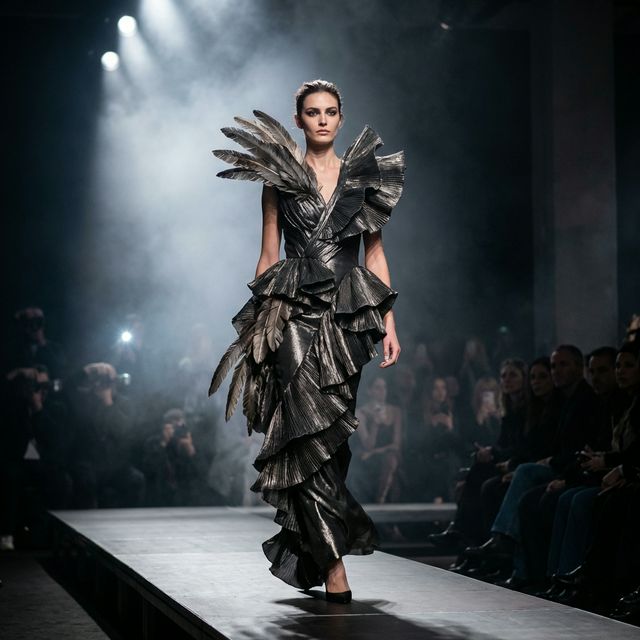
She appeared at the end of the show — the closing look, the position reserved for the ultimate statement. As the bass-heavy electronic soundtrack suddenly cut to silence, a single spotlight illuminated the far end of the runway. And there she was.
The gown was extraordinary: a floor-length, liquid-metal creation in hammered silver that moved like mercury with every step. Cut on the bias with architectural shoulders and a dramatic train that pooled behind her like molten starlight, the dress was both armor and vulnerability — a perfect metaphor for the journey that had brought her back to this moment. Her hair was pulled back into a severe, slicked bun, and her makeup was limited to a single element: a bold, dark lip that read as defiance.
"The moment she stepped out, everyone forgot about every other model, every other look, every other show that week. It was like watching a myth come to life. Fashion hadn't just missed her — fashion needed her." — Anna de Beaumont, Editor-in-Chief, Vogue Paris
Her walk — that famous, unhurried, almost predatory stride that had made her the most booked model of her generation — was exactly as the industry remembered it. But there was something new in her bearing, something that hadn't been there before. A stillness. A gravity. The kind of presence that comes only from having walked through fire and chosen to walk a runway again anyway.
The Three Silent Years
To understand the magnitude of this comeback, you have to understand the magnitude of the collapse that preceded it. Three years ago, at the peak of her career — 47 magazine covers in a single year, a Victoria's Secret headline spot, and an estimated annual income of $28 million — she simply stopped. No announcement. No farewell Instagram post. No transition to acting or business ventures. One day she was booked for sixteen shows at Milan Fashion Week, and the next, her agency released a one-sentence statement: "She is taking an indefinite break from all professional commitments."
What had happened behind the scenes, as those closest to her later revealed, was a catastrophic burnout that had been building for years. Working since the age of sixteen, she had spent a decade in an industry that demanded her body, her time, and her identity with relentless, punishing consistency. She was eating one meal a day, sleeping four hours a night, and flying between three continents in a single week — every week, for years on end.
"The industry doesn't let you be tired," she told Webloids in a rare pre-show interview. "It doesn't let you be sick, or sad, or anything other than perfect and available. I wasn't a person anymore. I was a product. And one day, the product broke."
Her retreat was total. She disappeared to a farmhouse in the Portuguese countryside — no social media, no emails, no visitors other than immediate family. For the first six months, she says, she did almost nothing. "I slept. I cried. I gardened. I learned to cook badly. I read books that had nothing to do with fashion or beauty or cameras. I remembered what it felt like to be a person who wasn't being watched."
The Road Back
The decision to return came slowly, and with conditions. She approached Alaric's Marcus Alaric directly — not through agents or managers — with a simple proposition: she would walk one show, one look, on her own terms. No pre-show press. No backstage cameras. No social media live streams. Just the walk.
Marcus Alaric, who had been a vocal critic of the fashion industry's treatment of models during her absence, agreed immediately. "When she called me, I didn't think twice," he said backstage after the show, still visibly moved. "I designed that dress for her in two days. Everything about it — the weight, the way it moves, the way the silver catches light — was built around the idea of someone returning to themselves. It's not a fashion moment. It's a human moment."
The show's other models — all of whom had been told about the surprise closing only hours before — reacted with awe. "I teared up backstage watching her get ready," said one. "She was calm, focused, completely present. There was no diva energy, no nerves. She just radiated this incredible peace. Like she had nothing left to prove and chose to be there anyway."
The Fashion World Responds
The response from the fashion industry has been overwhelming and unanimous. Within hours of the show, every major brand that had once counted her as their most valuable face made public overtures. Chanel's creative director posted a single black-and-white photo of her from a 2022 campaign with the caption: "She's back. Fashion is complete again." Versace offered a reported $15 million for an exclusive comeback campaign. Prada sent flowers to her London hotel.
But perhaps the most meaningful response came from the models and young women who had watched her departure as a wake-up call. "When she left, it forced the industry to reckon with how it treats people," wrote a prominent model-turned-activist on Instagram. "And now that she's back on her own terms, it shows that the reckoning wasn't in vain. You CAN walk away, heal, and come back stronger. That's the most powerful statement anyone has made on a runway this year."
As for what comes next, she's characteristically noncommittal. "I don't know if I'll do another show," she said. "I might. I might not. The difference now is that the choice is mine. And that changes everything."
London Fashion Week continues through February 18th. Webloids will be providing daily coverage of all major shows.
💬 Comments (3,204)
I actually started crying reading this. As someone who left a burnout-inducing corporate job last year, her story resonates so deeply. You CAN walk away and come back better. 💔→❤️